

Singapore’s tech startup ecosystem is undergoing rapid transformation in 2025, fueled by advancements in artificial intelligence (AI), data-driven decision-making, blockchain technology, and evolving consumer behavior. With increased competition and rising customer acquisition costs (CAC), tech startups must adopt innovative marketing strategies to remain competitive.
This report provides a comprehensive analysis of the latest marketing trends, along with actionable insights for startup founders looking to scale their businesses effectively. One key solution emerging is the adoption of fractional marketing teams, which provide cost-effective and scalable expertise for startups facing resource constraints.
Key Trends:
- AI-driven marketing automation and hyper-personalization.
- Increased reliance on data-driven decision-making for customer acquisition.
- The rise of Web3 and blockchain innovations in marketing.
- Growing adoption of short-form video content for B2B engagement.
- The importance of sustainability and compliance with evolving data privacy laws.
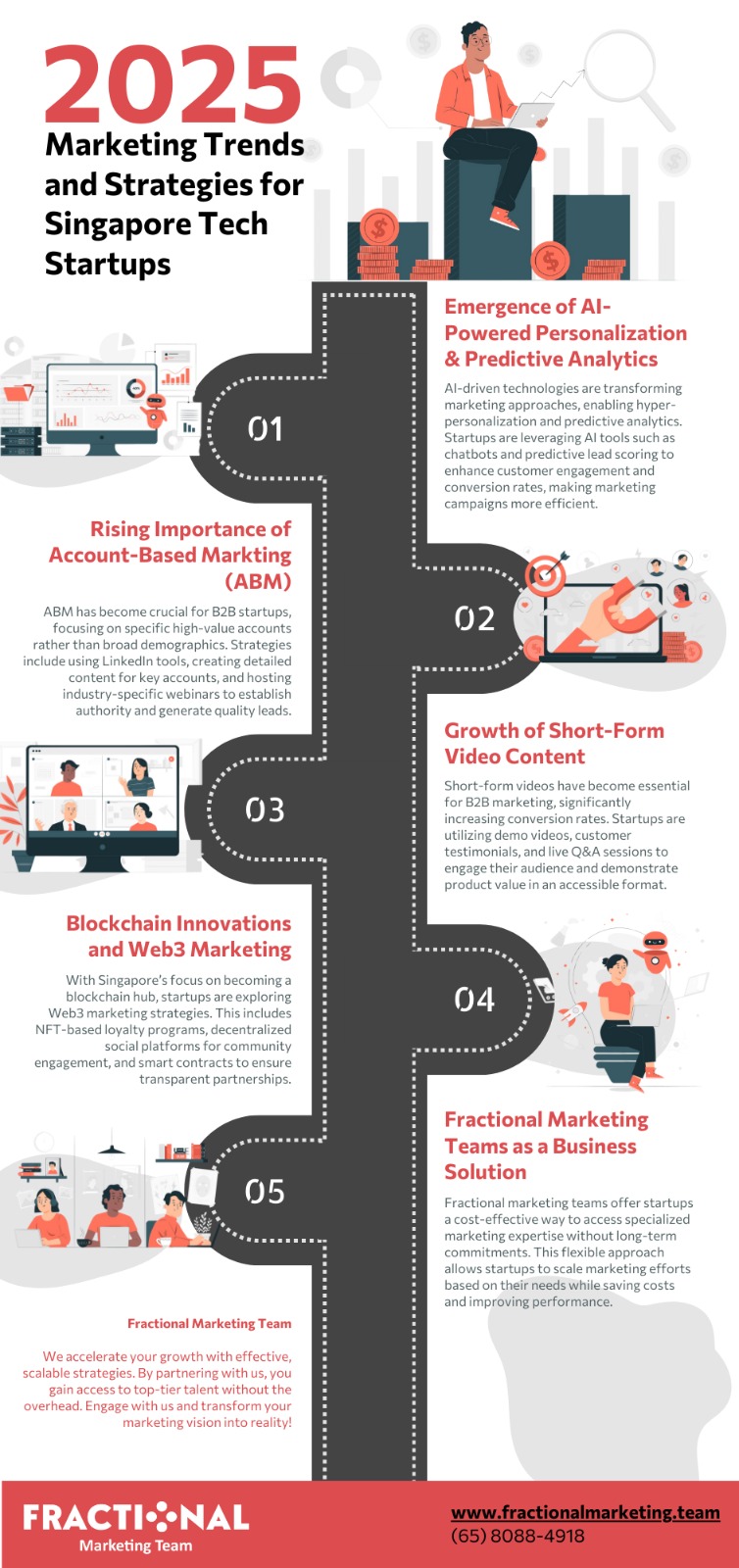
1. The Singapore Tech Startup Ecosystem in 2025
Singapore has solidified its position as one of Asia’s leading tech hubs, attracting significant global investment. According to the Singapore Economic Development Board (EDB), tech startups secured 35% of total venture capital investments in 2024, amounting to over SGD 3.2 billion.
However, tech startups still face various challenges, including:
- Talent Shortages – The demand for AI, blockchain, and cybersecurity experts has skyrocketed, making it difficult for startups to attract and retain skilled professionals.
- Competition from Global Giants – Startups struggle to differentiate themselves from multinational corporations with larger budgets and stronger brand recognition.
- High Customer Acquisition Costs (CAC) – Increasing competition for digital ad space has driven up the cost of acquiring new customers, making organic growth strategies more crucial.
Singapore’s government has implemented various programs to support tech startups, ensuring they remain competitive and innovative. These include:
- Startup SG Tech Grant – This initiative provides early-stage funding for innovative deep-tech startups, allowing them to focus on research and product development without immediate financial constraints.
- Productivity Solutions Grant (PSG) – Offers subsidies of up to 50% for startups adopting digital solutions, helping them improve operational efficiency and scale their businesses.
- Tech.Pass Program – Aimed at attracting global tech talent, this initiative helps startups gain access to highly skilled professionals in AI, cybersecurity, and fintech.
- Enterprise Development Grant (EDG) – Supports companies in capability upgrading, innovation, and international expansion.
- Smart Nation Initiative – Singapore’s push towards digital transformation, fostering AI and IoT innovation among startups.
2. Top Marketing Trends for Tech Startups in 2025
A. AI-Powered Personalization & Predictive Analytics
AI has revolutionized marketing, allowing businesses to create hyper-personalized campaigns that adapt to user behavior in real-time. Statista reports that 67% of Singaporean startups have integrated AI into their CRM systems by early 2025, significantly improving customer engagement and conversion rates.
Key Applications:
- AI-Powered Chatbots – Capable of handling complex customer inquiries, providing product recommendations, and even completing transactions without human intervention.
- Predictive Lead Scoring – AI can analyze user behavior patterns to predict which leads are most likely to convert, allowing startups to focus on high-value prospects.
- AI-Generated Content – Machine learning models can create personalized email campaigns, website content, and advertisements that resonate with individual users.
B. Account-Based Marketing (ABM) for B2B Growth
Account-Based Marketing (ABM) is proving to be an essential strategy for B2B tech startups targeting specific accounts rather than broad audiences. Forrester Research found that businesses using ABM strategies experienced a 208% increase in revenue compared to traditional marketing methods.
Implementation Strategies:
- LinkedIn Sales Navigator – A tool that allows startups to identify and engage with decision-makers at targeted companies.
- Whitepapers & Case Studies – Creating in-depth, research-backed documents tailored to key accounts helps establish credibility and trust.
- Industry-Specific Webinars – Hosting webinars addressing niche industry pain points can position startups as thought leaders and generate high-quality leads.
C. Thought Leadership Through Content Marketing
Content marketing continues to drive lead generation and brand authority. According to HubSpot, 72% of tech startups in Southeast Asia reported lead generation success through content marketing.
Best Practices:
- Founder-Driven Content on LinkedIn – CEOs and founders actively sharing insights, trends, and startup experiences can drive organic engagement and establish brand credibility.
- Research-Backed Reports – Publishing industry reports with proprietary data can attract media attention and inbound leads.
- Educational Podcasts & Webinars – Engaging potential customers through in-depth discussions on relevant topics strengthens industry authority.
D. Short-Form Video Marketing for Product Demos & Engagement
Short-form videos are now a staple in B2B marketing. Startups using video content on landing pages report an 80% increase in conversion rates, according to a study by Wyzowl.
Examples of Video Strategies:
- Demo Videos – Showing how a SaaS product works in real-time can significantly improve user adoption.
- Customer Testimonials – Short, engaging testimonials from satisfied customers help build trust with potential clients.
- Live Q&A Sessions – Hosting live sessions on platforms like LinkedIn and YouTube can drive engagement and address potential customer concerns directly.
E. Web3 & Blockchain Innovations in Marketing
With Singapore emerging as a blockchain innovation hub, Web3 marketing strategies are gaining traction.
Innovative Use Cases:
- NFT-Based Loyalty Programs – Some startups are introducing blockchain-based loyalty rewards to encourage customer retention.
- Decentralized Social Platforms – Leveraging blockchain for community engagement eliminates reliance on traditional social media algorithms.
- Smart Contracts for Transparent Partnerships – Automating influencer and brand partnership agreements through blockchain ensures transparency and efficiency.
3. The Role of Fractional Marketing Teams for Startup Growth
Many tech startups struggle with hiring full-time marketing teams due to budget constraints. Fractional marketing teams are emerging as a cost-effective solution, offering specialized expertise without long-term overhead costs.
Benefits of Fractional Marketing Teams:
- Cost Efficiency – Startups gain access to senior marketing strategists at a fraction of the cost of hiring a full-time Chief Marketing Officer (CMO).
- Scalability – Fractional teams allow businesses to adjust marketing efforts based on growth needs.
- Diverse Expertise – Access to specialists in SEO, content marketing, AI-driven campaigns, and paid advertising without needing multiple full-time hires.
4. Detailed Analysis of Marketing Trends
A. AI-Powered Personalization & Predictive Analytics
AI-Powered Chatbots
- AI-powered chatbots have become an indispensable tool for startups looking to enhance customer service and engagement. These chatbots are capable of handling complex customer inquiries, providing product recommendations, and even completing transactions without human intervention. According to a report by Gartner, by 2025, 80% of customer service interactions will be handled by AI-powered chatbots, up from 25% in 2020.
Predictive Lead Scoring
- Predictive lead scoring is another critical application of AI in marketing. By analyzing user behavior patterns, AI can predict which leads are most likely to convert, allowing startups to focus their efforts on high-value prospects. This not only improves conversion rates but also optimizes marketing spend. A study by Salesforce found that companies using predictive lead scoring experienced a 30% increase in sales productivity.
AI-Generated Content
- AI-generated content is revolutionizing the way startups create and distribute marketing materials. Machine learning models can generate personalized email campaigns, website content, and advertisements that resonate with individual users. This level of personalization can significantly improve engagement and conversion rates. According to a report by McKinsey, companies that leverage AI for content creation see a 20% increase in customer satisfaction and a 15% boost in sales.
B. Account-Based Marketing (ABM) for B2B Growth
LinkedIn Sales Navigator
- LinkedIn Sales Navigator is a powerful tool for startups implementing ABM strategies. It allows businesses to identify and engage with decision-makers at targeted companies, making it easier to tailor marketing efforts to specific accounts. According to LinkedIn, 87% of marketers say that ABM initiatives deliver a higher ROI than other marketing activities.
Whitepapers & Case Studies
- Creating in-depth, research-backed documents tailored to key accounts helps establish credibility and trust. Whitepapers and case studies are particularly effective in B2B marketing, as they provide valuable insights and demonstrate the startup’s expertise. A study by DemandGen Report found that 82% of B2B buyers are more likely to consider a vendor that offers relevant content.
Industry-Specific Webinars
- Hosting webinars addressing niche industry pain points can position startups as thought leaders and generate high-quality leads. Webinars provide an opportunity to engage with potential customers in real-time, answer their questions, and showcase the startup’s solutions. According to a report by ON24, 73% of B2B marketers say that webinars are the best way to generate high-quality leads.
C. Thought Leadership Through Content Marketing
Founder-Driven Content on LinkedIn
- CEOs and founders actively sharing insights, trends, and startup experiences can drive organic engagement and establish brand credibility. LinkedIn is an ideal platform for this type of content, as it allows founders to connect directly with their target audience. According to LinkedIn, posts from company founders receive 3x more engagement than posts from other employees.
Research-Backed Reports
- Publishing industry reports with proprietary data can attract media attention and inbound leads. These reports provide valuable insights and position the startup as a thought leader in its industry. A study by Edelman and LinkedIn found that 58% of decision-makers spend at least one hour per week reading thought leadership content.
Educational Podcasts & Webinars
- Engaging potential customers through in-depth discussions on relevant topics strengthens industry authority. Podcasts and webinars are particularly effective for reaching busy professionals who prefer to consume content on the go. According to a report by Nielsen, 54% of podcast listeners are more likely to consider buying from a brand after hearing it advertised on a podcast.
D. Short-Form Video Marketing for Product Demos & Engagement
Demo Videos
- Showing how a SaaS product works in real-time can significantly improve user adoption. Demo videos provide a clear and concise overview of the product’s features and benefits, making it easier for potential customers to understand its value. According to a study by Wyzowl, 96% of people have watched an explainer video to learn more about a product or service.
Customer Testimonials
- Short, engaging testimonials from satisfied customers help build trust with potential clients. Testimonials provide social proof and demonstrate the startup’s ability to deliver results. According to a report by BrightLocal, 91% of consumers trust online reviews as much as personal recommendations.
Live Q&A Sessions
- Hosting live sessions on platforms like LinkedIn and YouTube can drive engagement and address potential customer concerns directly. Live Q&A sessions provide an opportunity to interact with the audience in real-time, answer their questions, and build a stronger connection. According to a report by Livestream, 80% of audiences would rather watch live video from a brand than read a blog post.
E. Web3 & Blockchain Innovations in Marketing
NFT-Based Loyalty Programs
- Some startups are introducing blockchain-based loyalty rewards to encourage customer retention. NFTs (non-fungible tokens) can be used to create unique, digital assets that customers can collect and redeem for rewards. According to a report by Deloitte, 55% of consumers are interested in participating in NFT-based loyalty programs.
Decentralized Social Platforms
- Leveraging blockchain for community engagement eliminates reliance on traditional social media algorithms. Decentralized social platforms provide a more transparent and user-controlled environment for community building. According to a report by Gartner, by 2025, 20% of social media platforms will be decentralized.
Smart Contracts for Transparent Partnerships
- Automating influencer and brand partnership agreements through blockchain ensures transparency and efficiency. Smart contracts can be used to automate payments, track performance, and enforce terms, reducing the risk of disputes. According to a report by PwC, 45% of companies are exploring the use of smart contracts for partnership agreements.
5. The Role of Fractional Marketing Teams for Startup Growth
Cost Efficiency
Fractional marketing teams offer a cost-effective solution for startups that need senior-level expertise but cannot afford to hire a full-time CMO. By hiring a fractional team, startups can access the skills and experience of seasoned marketing professionals at a fraction of the cost. According to a report by Deloitte, startups that use fractional teams save an average of 40% on marketing costs compared to hiring full-time employees.
Scalability
Fractional marketing teams provide the flexibility to scale marketing efforts up or down based on the startup’s growth needs. This is particularly important for startups that experience fluctuating demand or are in the early stages of growth. According to a report by McKinsey, 65% of startups that use fractional teams report being able to scale their marketing efforts more effectively.
Diverse Expertise
Fractional marketing teams offer access to a wide range of specialized skills, including SEO, content marketing, AI-driven campaigns, and paid advertising. This allows startups to benefit from a diverse set of expertise without needing to hire multiple full-time employees. According to a report by Gartner, 70% of startups that use fractional teams report improved marketing performance due to access to specialized skills.
Conclusion
—
The Singapore tech startup ecosystem is evolving rapidly, driven by advancements in AI, data-driven decision-making, blockchain technology, and changing consumer behavior. To remain competitive, startups must adopt innovative marketing strategies that leverage these trends. Fractional marketing teams offer a cost-effective and scalable solution for startups looking to access senior-level expertise and specialized skills.
By embracing AI-powered personalization, account-based marketing, thought leadership through content marketing, short-form video marketing, and Web3 innovations, startups can differentiate themselves in a crowded market and achieve sustainable growth. As the ecosystem continues to evolve, startups that stay ahead of these trends will be well-positioned to succeed in 2025 and beyond.





Leave a Reply