
Introduction: When the Tide Goes Out
Warren Buffett famously said, “Only when the tide goes out do you discover who’s been swimming naked.”
In business, a downturn is that moment. Budgets shrink. Buyers hesitate. Teams get leaner. For startup founders, marketing leaders, and revenue teams, it raises a sharp question:
“How do we market when spending slows, competition tightens, and every dollar must work twice as hard?”
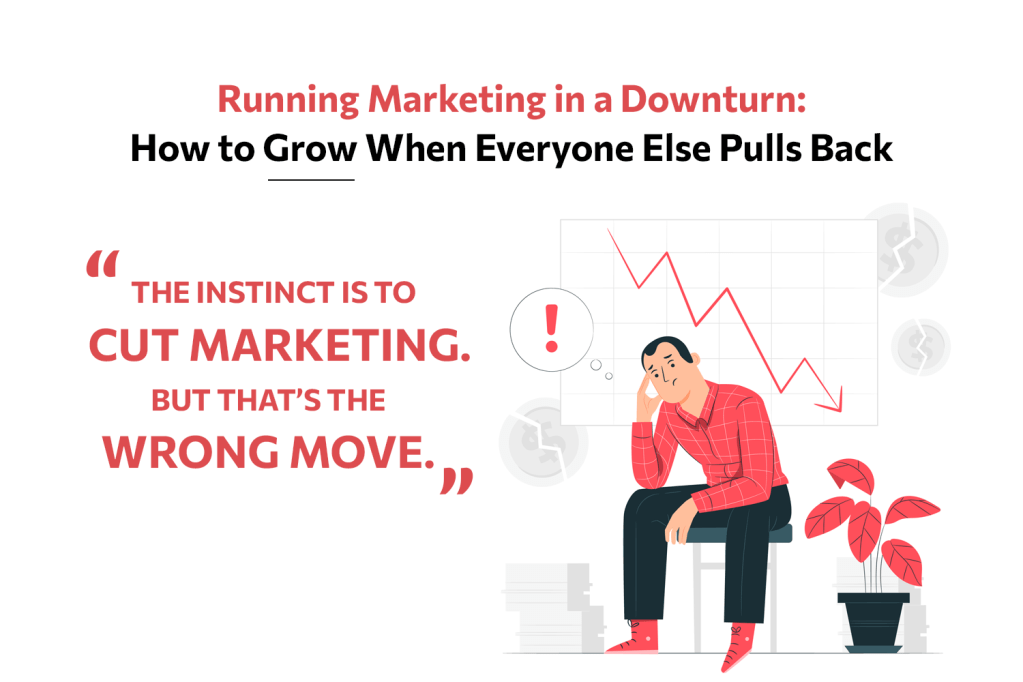
The instinct is to cut marketing. But that’s the wrong move.
History shows companies that maintain or smartly reallocate their marketing during downturns outperform competitors during recovery. Why? Because they stay top of mind, build trust, and seize market share while others go quiet.
This guide offers a playbook for lean, focused, and ROI-driven marketing in a recession or economic slowdown. It’s built for founders, CMOs, and marketing teams under pressure to deliver growth with fewer resources.
We’ll cover:
– Resetting strategy to meet new market realities
– High-impact channels and tactics that work in a downturn
– How to reframe messaging for cost-sensitive buyers
– What to pause, optimize, or eliminate
– Building an agile, cost-effective execution model (hint: fractional teams)
– Metrics that actually matter now
– How to position yourself to thrive when the market rebounds
1. Rethink Your Strategy: It’s Not Business as Usual
In a downturn, your old playbook may not fit. Buyer behavior, risk tolerance, and priorities change. It’s time to recalibrate your marketing foundations.
Re-evaluate Your ICP
Your ideal customer profile might shift. Ask:
- Who still has budget?
- Who has a ‘must-solve pain‘ for you to uniquely address?
- Are there industries or segments less impacted?
- Is the buyer persona different now (e.g. CFO instead of marketing)?
Reposition Your Product
Downturns accelerate practical buying. Your positioning should reflect:
- Efficiency, ROI, savings
- Risk reduction or compliance
- Time to value (TTV)
Shift from aspirational to operational.
Example:
- Before: “Empower your brand with marketing automation.”
- After: “Cut acquisition costs by 40% with smarter automation.”
Reprioritize Your Marketing Goals
Focus on:
- Revenue and pipeline, not just leads
- Retention and expansion (often cheaper than acquisition)
- CAC reduction and sales velocity
You’re not just trying to grow — you’re trying to grow smart.
2. Double Down on High-Impact, Low-Cost Channels
You can still make a big impact — but with precision.
Email Marketing
Still the highest ROI channel. Focus on:
- Lifecycle nurturing
- Lead reactivation
- Customer upsell/cross-sell campaigns
- Win-back sequences
SEO and Content
- Refresh and repurpose existing blog posts and landing pages
- Focus on bottom-of-funnel content: buyer’s guides, comparison pages, case studies
- Target pain-point keywords (“[product] alternative,” “best affordable [solution]”)
Founder and Team-led LinkedIn Content
People buy from people. Founder and team content builds brand trust. Use:
- Weekly value posts
- Customer stories
- “Here’s how we saved X company $50k in Q1” posts
Partnerships and Ecosystem Co-Marketing
- Co-branded webinars or guides with non-competing tools
- Bundled offers
- Distribution partnerships
Conversion Optimization
- Improve what you already have: landing pages, forms, checkout flows
- Focus on intent-rich pages (demo, pricing, product)
3. Pause or Pivot What’s Not Performing
Downturns demand discipline.
What to Pause or Scale Down
- Paid ads with poor CAC or unclear targeting
- Events with no clear lead-gen ROI
- Vanity PR or brand campaigns not tied to conversions
What to Optimize
- Leaky funnel stages
- Inactive email lists
- Underperforming website assets
Smart Alternatives
- Replace live events with webinars
- Replace brand videos with founder-led Looms
- Replace broad paid campaigns with retargeting and high-intent search ads
4. Reframe Messaging for Cost-Conscious Buyers
During downturns, buyers don’t stop buying — they buy differently.
Adjust Your Messaging Pillars:
| Old Messaging | New Messaging |
| Disruption / Innovation | Cost-saving / Efficiency |
| Aspirational Value | Tangible ROI / Time-to-Value |
| Growth Potential | Risk Mitigation |
| Nice-to-have | Must-have / Compliance / Mission-Critical |
Build Recession-Proof Proof Points:
- Quantify savings: “Cut churn by 30%”
- Highlight speed: “Go live in 7 days”
- Emphasize ROI: “Payback in 90 days”
5. Move Faster with a Leaner Execution Model
Speed + flexibility wins now. This is where fractional marketing teams shine.
Why Fractional Wins in a Downturn
- Lower cost than full-time hires (no benefits, office, equity)
- Plug-and-play teams (strategist + executors)
- Short-term commitments (3–6 month sprints vs. annual headcount)
- Cross-functional expertise without hiring multiple people
What a Fractional Team Can Do
- Refresh your GTM strategy
- Reposition and rewrite your messaging
- Run lean growth experiments
- Build and launch revenue-focused campaigns
- Manage content, paid, SEO, lifecycle, or product marketing as needed
6. Measure What Matters (and Cut What Doesn’t)
Forget vanity metrics. Focus on survival and efficiency metrics.
Essential Metrics
| Funnel Stage | What to Track |
| Awareness | Organic traffic, Cost per Lead (CPL) |
| Engagement | Email opens/clicks, time on page |
| Acquisition | CAC, Conversion Rate, Sales Velocity |
| Retention | Churn, NPS, Expansion Revenue |
| Efficiency | LTV:CAC, Payback Period, Pipeline Coverage |
Create a Lean Dashboard
Use free or low-cost tools (e.g. Google Sheets + Data Studio) to track:
- Pipeline by source
- Channel performance
- Funnel drop-off
- Campaign ROI
Review bi-weekly, not monthly. Make faster decisions.
7. Stay Present — Even Quietly
Don’t go dark just because others do.
Maintain a Consistent (Lean) Brand Presence
- Weekly LinkedIn posts (personal + brand)
- Monthly newsletter
- Lightweight customer interviews or updates
- “Behind-the-scenes” content — show you’re building
Silence kills trust. Even small touches build brand memory.
Summary: Be Bold, Be Lean, Be Useful
Running marketing in a downturn isn’t about cutting everything. It’s about:
- Refining your strategy
- Focusing on what works
- Reframing your message
- Executing lean
- Staying visible and helpful
- Tracking ruthlessly
And most importantly — it’s about staying in the game while others pull back.
The brands that grow during a recession often become category leaders afterward. But you can’t wait for perfect conditions.
Need to Stay Lean but Still Grow?
At FractionalMarketing.Team, we help startups and growth-stage companies run revenue-focused marketing with fractional marketing teams that scale with your needs.
Whether you’re cutting burn or ramping up smarter — we’ll help you build, launch, and grow without overhead.




 Fractional Marketing Team
Leave a comment